Speech
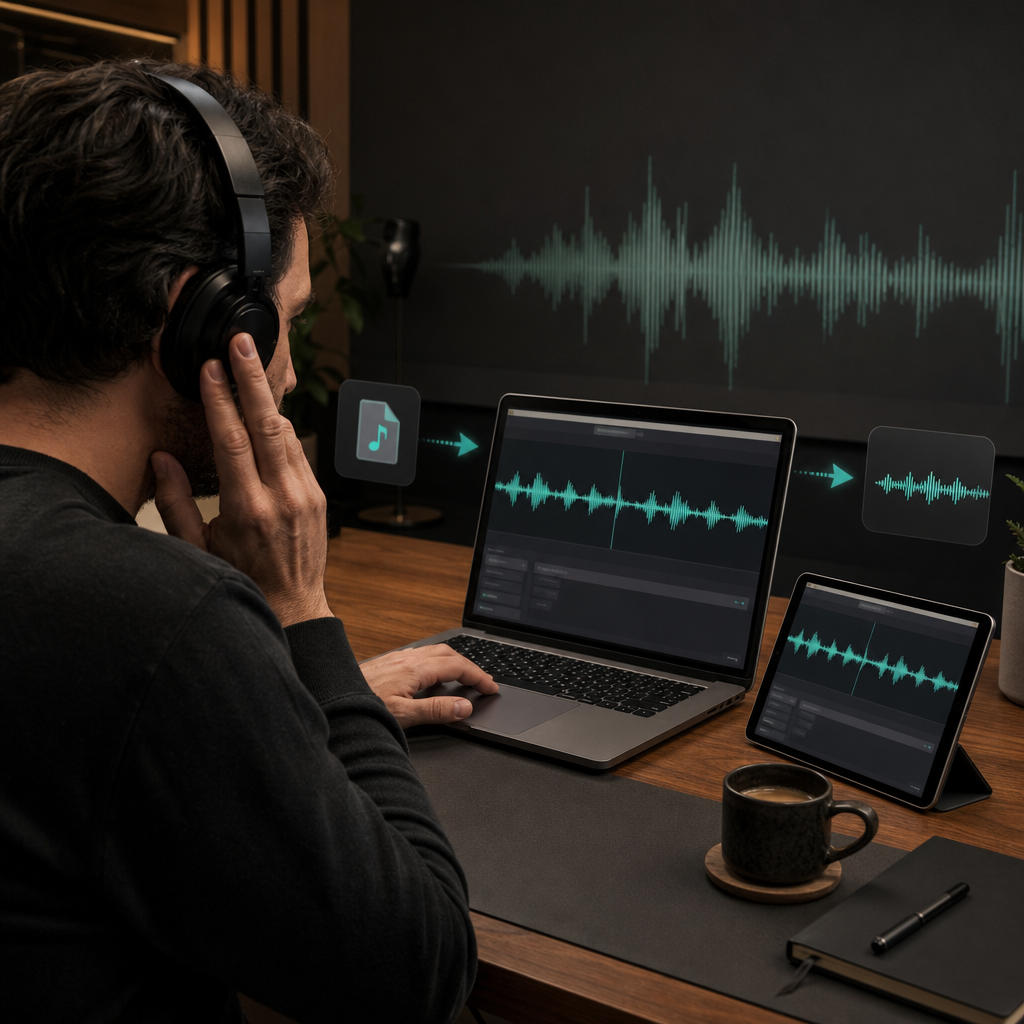
Extract dialogue from a music-backed clip
Bring narration or conversation forward for transcription, editing, accessibility, or a new mix.

To remove music from audio, separate the mixed signal into voice-focused and instrumental layers. Results are strongest when the vocal remains distinct; heavy compression, reverb, and overlapping frequencies can leave audible music or voice fragments.
The desired result depends on whether you need speech, singing, or the instrumental bed.
Speech
Bring narration or conversation forward for transcription, editing, accessibility, or a new mix.
Vocals
Reduce instrumental content around sung vocals for remix references, practice, and creative production.
Instrumental
Use the separated music for karaoke practice, arrangement study, or a new vocal performance where rights allow.

A separated layer needs enough clarity and continuity for its next purpose.
FOCUS
The wanted voice or music should lead without constant competition from the other layer.
LOW
Leftover fragments should remain quiet enough not to distract from editing or listening.
WHOLE
Words, sustained notes, and transitions should remain connected rather than broken into artifacts.
Listen for the target layer and the artifacts left behind by the removed layer.
The hardest overlap reveals the real quality of the separation.
Long tones often expose warbling, phase-like texture, and residual bleed.
Transcription may tolerate more artifacts than a remix, acapella, or polished dialogue edit.
Separation creates flexible layers from material that arrived as one finished mix.
Dialogue
Useful for interviews, documentaries, presentations, and archived clips where music competes with words.
Practice
Focus on one musical part for rehearsal, arrangement analysis, or learning.
Production
Create a practical starting point for remixing, replacement narration, or alternate versions.
Transcription, acapella work, and instrumental practice tolerate different levels of bleed and artifacts.
“A recorded interview has clear answers, but the music bed is too loud for accurate transcription.”
Documentary dialogue
Speech extraction
“A singer wants to study phrasing without the full arrangement masking softer details.”
Vocal reference
Acapella focus
“A practice track needs the instrumental layer without the original lead vocal.”
Karaoke rehearsal
Backing track isolation
Voice and music often share the same frequencies, timing, and stereo space.
Guitars, synths, and cymbals can overlap heavily with consonants and vocal harmonics.
Reflections spread the voice into the same space occupied by the music.
Compression and limiting bind the layers together, making clean isolation more difficult.
The best isolated layer is the one that works for the next task.
WORDS
Speech intelligibility matters more than a perfectly natural background texture.
TONE
Vocal continuity and timbre matter through sustained notes and breaths.
SPACE
The accompaniment should remain coherent when the lead vocal is reduced.
Technical separation does not change ownership, licensing, or permission.
Rights
Only reuse separated vocals or music when you have the rights or permission required for the intended use.
Privacy
Isolation can make previously obscured conversation easier to understand.
Attribution
Creative edits should preserve the attribution and licensing obligations attached to the material.
Choose a subscription for steady production or buy credits when you need flexible generation.
Arrangement density, reverb, and shared frequencies determine how cleanly layers can separate.
Yes. Voice-focused separation can reduce a music bed and make speech easier to hear, although instruments sharing vocal frequencies may leave residual bleed.
Yes. Vocal and instrumental stems can support acapella listening, practice, remix preparation, or backing-track creation when the source rights permit it.
Voice and instruments often overlap in frequency and reverb, so a small amount of bleed may remain.
Not always. Sparse arrangements often produce a more natural extracted voice than dense, heavily compressed mixes with strong reverb and frequency overlap.
Only when you have the necessary rights or permission for the source recording and composition.
No. Music separation targets structured musical layers, while noise reduction targets unwanted environmental or technical sound.
It needs enough clarity for the next listening, editing, or practice goal.
“Speech extraction succeeds when the words become reliable enough to edit or transcribe.”
Dialogue stem
Intelligibility
“An instrumental practice track succeeds when the arrangement remains steady without a dominant lead vocal.”
Music stem
Rehearsal
Bring voice forward, reduce the music bed, or create a cleaner instrumental layer for your next edit.